


DnD modules save Dungeon Masters time and bring structure to the table — if you know how to read them, trim them, and adapt them for your group.
In this guide, we’ll walk through a practical, repeatable process: choosing the right module, prepping like a pro in under 90 minutes, pacing your sessions like a movie, and tuning encounters without losing flow.
By the end, you’ll know exactly how to make published adventures work for you, not the other way around.
What DnD modules are (and what they’re not)
Module vs. campaign vs. anthology
A DnD module is a pre-written adventure — typically designed for one to five sessions — with a clear story premise, locations, encounters, and rewards.
A campaign (or Adventure Path) is a longer narrative built from several modules, often spanning many levels.
An anthology (like Candlekeep Mysteries, which includes 17 adventures) bundles short, standalone stories that you can run as one-shots or link into a mini-campaign.
When to choose which:
- Module → perfect for contained side quests, tone shifts, or breaks between larger arcs.
- Campaign → when you want a consistent storyline and recurring characters.
- Anthology → great for flexible tables, rotating players, or seasonal play.
Strengths and trade-offs
Strengths: reduced prep, tested structure, ready-made maps, NPCs, and rewards.
Trade-offs: modules can feel rigid if you follow them word-for-word — leading to “railroading” or pacing dips.
Pro tip: treat the module as a toolbox, not a script. Move scenes, cut filler travel, and remix hooks to fit your players’ goals.
For deeper inspiration, check out The Alexandrian’s node-based design and Sly Flourish’s Lazy DM prep — both advocate building around player decisions, not static sequences.
Choosing the right DnD module for your table
Match level, tone, and time budget
A good fit is everything.
Check the level range (and whether it scales cleanly), clarify the tone (grim horror, heroic epic, or whimsical adventure), and decide your time budget — a one-shot, 3-session arc, or mini-campaign.
Misaligned tone is the fastest way to lose engagement.
Assess prep load
Before committing, ask:
- How many chapters must I read to run the first session confidently?
- How many NPCs or factions require tracking?
- How much travel or downtime can be compressed?
If the module expects 100+ pages of prep before session one, split it — open with a cold start, then expand.
Social contract and safety tools
Even the best modules can derail without tone and consent alignment. Use a quick check-in for boundaries (violence, horror, romance).
The free Consent in Gaming guide and the TTRPG Safety Toolkit are excellent DM resources.
Pro-level module prep in 60–90 minutes
Read once, map once
Skim the adventure for its core spine — hook → 3–6 key beats → finale.
Mark entrances, exits, timers, and fail-forward points (how the story moves when players fail rather than stall).
The one-page module brief
Condense the entire module into one reference card:
- Title:
- Level range / party:
- Premise (1–2 lines):
- Opening hook (linked to PCs):
- Key scenes (3–6 beats):
- Villain goals & clocks:
- Allies/factions (attitude, leverage):
- Terrain & set pieces:
- Fail-forward triggers:
- Treasure & advancements:
- Exit ramps (handoffs to campaign):
Table tools that save time
- Rumor tables & handouts: deliver exposition through discovery, not monologue.
- Clocks & timers: create urgency without removing choice.
- Initiative cards & fronts: track chaos and factions cleanly.
For more structure ideas, revisit The Alexandrian’s scenario design and Sly Flourish’s Lazy DM checklist.
Case study: from zero to table in 25 minutes with Ready, Set, Encounter! — Vol. 1
Sometimes you don’t have hours to prep — and that’s where modular design shines.
The challenge
It’s Thursday, 6:30 p.m.
Your players arrive at 7 p.m.
You need a tense, self-contained “dragon cult vault” encounter that fits your ongoing campaign — and it must be ready now.
The toolkit
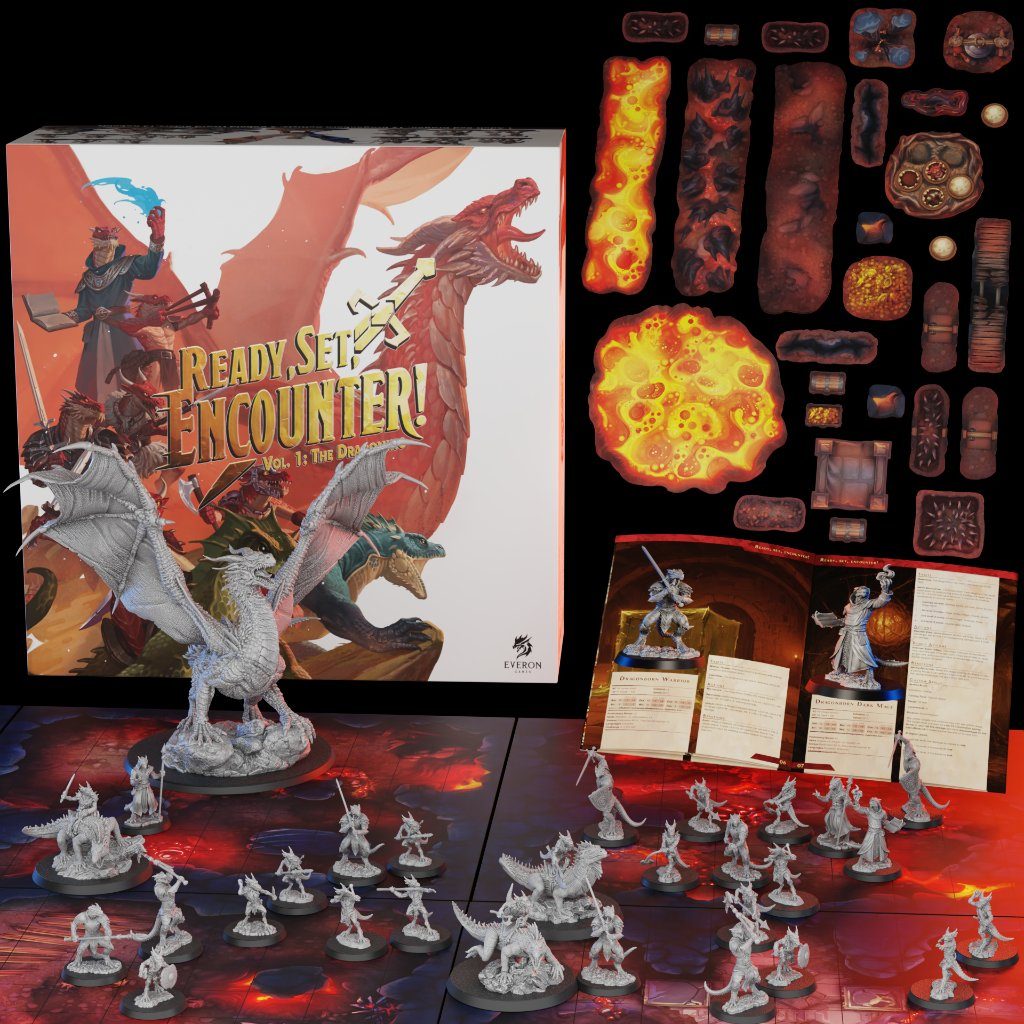
We used Ready, Set, Encounter! — Vol. 1: The Dragoning, EverOn’s all-in-one encounter box built for no-prep play:
31 miniatures, 11 double-sided map tiles, and a concise adventure booklet with stat blocks, terrain effects, and story hooks. Everything inside is 5e-compatible and ready to run right out of the box.
The timeline (25 minutes total)
- 0:00 – 5:00 — Create the one-page brief.
Premise: a stolen wyrmling heart powers a forbidden vault. Hook: an ally begs for help before it explodes. - 5:00 – 12:00 — Assemble the map.
Three modular tiles form a vault loop (entrance → puzzle lock → reliquary) with one optional detour room. - 12:00 – 18:00 — Tune the encounter.
Boss = elite cult champion (two turns) + minion acolytes; lair pulse every 2 rounds. - 18:00 – 22:00 — Add environmental tension.
Vertical gantry, chain platforms, hazard zones near the heart-engine. - 22:00 – 25:00 — Set the clock.
Ritual completes in six ticks; players can steal, destroy, or bargain with the artifact.
The result
- Cinematic pacing: one major conflict every ~70 minutes.
- Player agency: three possible resolutions.
- Zero scramble: maps, minis, and stat cards handled prep for you.
- Campaign continuity: the stolen artifact became the next arc’s hook.
Takeaway: with well-designed modular tools, you can deliver professional-level encounters in minutes, not hours.
Explore the booklet preview to see how each tile and stat block works in practice.
Pacing that feels cinematic (without railroading)
Three-act beats inside a module
Almost every adventure can fit into a mini three-act shape:
- Opening: the hook and first meaningful choice.
- Middle: rising tension and twists.
- Finale: confrontation or escape with consequences.
Timers and clocks
Add heartbeat to your world: a ritual completes in six ticks, guards rotate in ten minutes, the storm hits at midnight. Timers keep urgency alive without forcing direction.
Cut travel, spotlight the meaningful
Montage the road unless the journey is the story.
Each spotlight scene should yield a discovery, decision, or change in stakes.
Pro tip: plan one major conflict every 60–90 minutes and bridge them with quick transitions.
Encounter tuning for DnD modules
Fix the action economy first
Bosses lose when they act once per round.
Upgrade key foes into elites (two turns) or give legendary/lair actions to even the tempo.
Add minions to absorb player actions.
For more on this, see The Monsters Know What They’re Doing.
Terrain is damage
Vertical layers, shifting zones, moving hazards, collapsing bridges — terrain that demands movement turns basic fights into memorable set pieces.
Telegraph danger
Use foreshadowing — scars, rumors, footprints — to make deadly moments fair and tense rather than arbitrary.
Add morale checks or surrender options for realism.
Fast scaling dials
If difficulty feels off mid-combat:
- Too easy → +25 % enemy damage, add one minion per PC, trigger lair actions every two rounds.
- Too hard → −20 % elite HP, give players a one-time breather, or open a retreat route.
Running DnD modules inside a living campaign
Hook the module to a PC bond
Swap generic patrons for personal ties: an old mentor, rival, or family member. Players invest faster when it matters to their story.
Reskin NPCs and treasure
Change names, factions, or rewards to match your campaign’s tone. Treasure should advance goals — a key, favor, or clue beats a pile of gold.
Plan exit ramps
Design 2–3 ways out: a fleeing villain with new intel, a patron offering the next job, or a recovered relic that re-enters your main narrative.
Quick fixes for common module problems
Dead ends
Always include two sources per crucial clue — redundancy keeps the story alive.
Travel slog
Montage uneventful journeys. Include one meaningful encounter or omen en route.
Difficulty spikes
Foreshadow deadly areas and allow negotiation, stealth, or rerouting as alternatives.
Lore dumps
Spread exposition across three scenes and voices — a mural, a letter, an NPC confession.
Pro tip: failure should move the world forward, not stall it. Fail forward.
When modules feel too rigid: flexible adventure toolkits
If a module feels like a railroad, shift to a branching design.
Not like modules that leave no space for creativity
EverOn Adventure Toolkits are choose-your-own-adventure-style resources with branching scenes and scene tags.
They keep structure while leaving room for improvisation and player choice.
Drop-in use cases
- Side quest for any level
- Bridge between arcs
- Tone pivot (from grim dungeon to intrigue or comedy)
Blend examples
- Skin of a Killer — perfect gothic finale for an urban storyline.
- Say Cheese — comic-horror interlude between serious chapters.
Try it yourself: download a free EverOn toolkit and drop it into your campaign this week.
Table procedures that keep you in control
The first ten minutes
Recap the last session, confirm the party’s direction, and restate active timers.
A structured start avoids aimless wandering.
Spotlight balance
Check every 20–30 minutes: who hasn’t had the spotlight? Offer tailored hooks or challenges.
Safety and tone alignment
Reaffirm tone (grim, swashbuckling, whimsical) and keep safety tools available — open-door and X-card systems prevent uncomfortable surprises.
Post-session wrap and prep for next time
- Update clocks and fronts: which factions advanced or retreated?
- Foreshadow: drop one strong teaser for next time.
- Loot & advancement: handle rewards transparently, outside the spotlight.
Printable checklists for running DnD modules
Pre-session checklist (DM)
- Hook tied to a PC goal
- 3–6 key scenes with entrances/exits
- One pressure clock, one villain clock
- Two escape hatches (negotiation or detour)
- Scaling plan for easy/hard
- Rumor or handout table ready
Encounter tuning card
- Action-economy fix planned
- Terrain feature chosen
- Danger telegraphed
- Scaling dials ready
One-page module brief (PDF)
Store your briefs in your Library for instant reuse.
FAQ: running DnD modules
What are DnD modules?
Pre-written adventures containing storylines, encounters, maps, NPCs, and guidance for Dungeon Masters.
How long should a module session be?
Most groups fit one major conflict every 60–90 minutes; a full session runs 3–4 hours comfortably.
How do I shorten a module into a one-shot?
Cut travel, compress side quests into rumor tables, pre-seed the hook, and add a visible timer so the story ends decisively.
Can I mix a module with my home campaign?
Absolutely. Connect its hook to a PC bond, reskin NPCs, and plan exit ramps that lead back to your main arc.
How do EverOn toolkits differ from DnD modules?
Toolkits use branching structures and modular scenes, giving GMs flexibility while maintaining balance — no railroads, just story momentum.
Final thoughts
Running a module “like a pro” isn’t about memorizing 100 pages — it’s about intentional design.
Prep what matters, tune what breaks, and keep the focus on decisions that change the world.
Modern DnD thrives on flexibility: modular products like Ready, Set, Encounter! and EverOn’s Adventure Toolkits prove you can have structure and freedom.
Whether you’re new to published adventures or remastering classics, start with one rule:
Run the module — don’t let it run you.
Ready to upgrade your prep?
👉 Grab a free EverOn toolkit
